Stop Dirty Data Deals: a statewide pause on Queensland data centres
Stop Dirty Data Deals
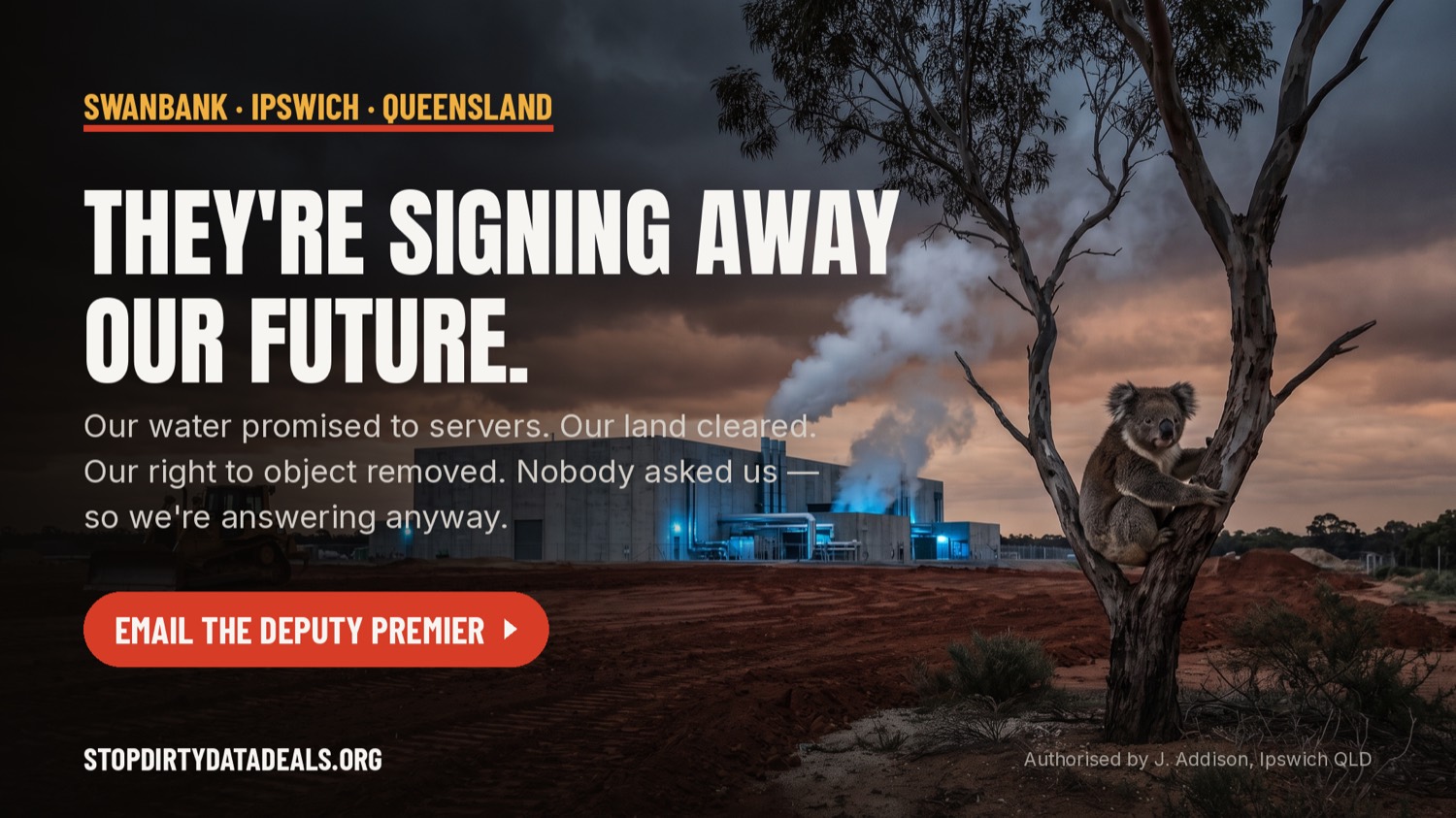
Queensland is being carved up for AI data centres with no rules and no say. Swanbank, in Ipswich, is the prime threat. Tell the Deputy Premier to hit pause while the rules catch up.
The Problem
This feels like history repeating.
A private company wants to build a large AI data centre at Swanbank. Facilities like these run around the clock and can draw enormous amounts of power and water. Around the world, unchecked AI data centre development is putting real strain on local communities: their power, their water, and their household bills.
For our part of Ipswich, this reopens an old wound. For twenty years we have carried the state's waste. The odours, the air pollution, and the feeling that decisions were made about us without us. It wore the community down, and it taught us to read the warning signs early.
Now it feels like history repeating, this time with a facility that could push up our power prices and put pressure on our water supply.
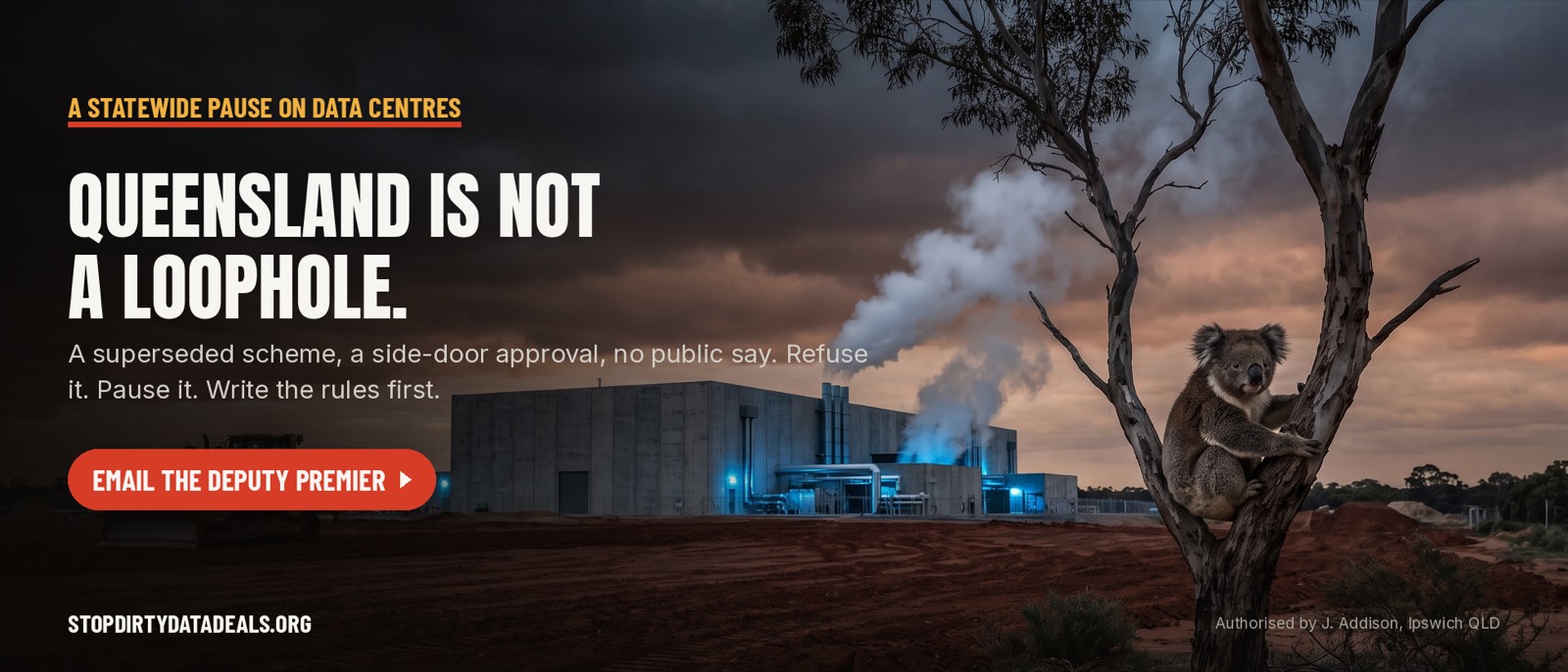
Here is what makes it worse. The application is being handled as code assessable under a superseded planning scheme. In plain terms, that means no public notification, no chance for residents to make a submission, and no community right of appeal. A project of this scale should not be waved through a side door.
Australia's own standards for AI are not due to be implemented until early 2027. Until then we have no proper framework to assess something this big. We are not saying never. We are saying not like this, and not yet. Give the community a one-year moratorium so the rules can catch up.
In their own words
We're not speculating. We're reading their application back to them.
Every quote below is lifted straight from the applicant's town planning report (Application 12285/2026/MCU). This is the case they are making, in their words.
will likely connect into this existing main as a primary and uninterrupted source of water supply
What that means: their Plan A for cooling is our public drinking-water network.
the bushfire hazard will be removed due to the proposed vegetation clearing
What that means: their bushfire plan is to bulldoze the bush, which is mapped koala habitat.
not considered to be critical to the determining of a superseded planning scheme request
What that means: approve first, check the ground is stable later.
public notification is not required
What that means: they've engineered the process so residents can't formally object.
What we know
The scale, in their own numbers.
These figures come from the applicant's town planning report (Application 12285/2026/MCU). Several are deliberately hedged, exactly as the application words them. We will not present uncertain numbers as fact.
Stated in the applicant's town planning report.
~72 m
Their report quotes 72.25 m, 77.25 m and 70.87 m in different places. Their own numbers don't line up.
The report states "access to natural light/openings are not required".
Alongside 589 car spaces. A huge footprint for modest ongoing jobs.
Their own words for the town's potable supply.
A State matter of environmental significance. The applicant's consultant argues it is "limited" value.
The subsidence and geotechnical study is deferred until after this decision.
The gap we're being rushed through. A one-year pause lets the rules catch up.
Frequently asked
The questions that deserve answers.
Yes, as its main supply, on their own account. The application states the data centre "will likely connect into this existing main as a primary and uninterrupted source of water supply" and that it will "generate significant water demand".
The mains at Six Leaf Street are part of the public (Urban Utilities) network. A hyperscale facility that needs the town's drinking-water main as its primary, uninterrupted source is telling us it can't meet its own demand independently.
Ten storeys and roughly 72 to 77 metres tall (their report quotes 72.25 m, 77.25 m and 70.87 m in different places), with a gross floor area of 82,575 m², running 24 hours a day, 7 days a week. It is windowless: "access to natural light/openings are not required".
Yet it is staffed at a peak of about 176 people, with 589 car spaces. An enormous footprint and resource draw, for modest ongoing jobs.
The site is mapped by the State as Core Koala Habitat. The proposal is to clear mapped vegetation and core koala habitat exceeding the exemption threshold, which triggers a State referral.
The applicant's own consultant argues the site has "limited koala habitat value" and proposes offsets elsewhere. When the State says "core koala habitat" and the developer's consultant says "don't worry about it", it's fair to ask whose map you'd trust.
Swanbank is known undermined land. The applicant says the mine-subsidence and geotechnical report is "not considered to be critical" to this decision and will be provided later.
So approval is being sought for a 10-storey, 82,575 m² building over historic mine workings before the ground-stability study is even assessed. That is backwards.
Because the application is Code Assessment, "public notification is not required". The applicant has asked to use the superseded 2006 planning scheme instead of the current Ipswich City Plan 2025 (in effect since 1 July 2025), and drawn a "metes and bounds" boundary that excludes the buffer zone so an extra assessment step "does not apply".
Three moves that together remove notification, submission and appeal rights. The important part: Council must agree to the superseded-scheme request for any of it to work. If Council refuses, the current rules apply.
What we're calling for
A fair process, not a fast one.
What we're asking for
- Refuse the superseded 2006 scheme request.
- Assess it as impact assessable: notification, submissions and appeal rights.
- A one-year statewide moratorium on new data centre approvals, and the Minister to call in Swanbank now.
- Full public disclosure of power, peak water, generators and fuel, vegetation and koala impact, and mine-subsidence findings.
- A condition that the operator provides or pays for its own power and water.
The current process
- Superseded 2006 planning scheme.
- Code assessable.
- No public notification.
- No submissions. No appeal rights.
- Mine-subsidence study deferred until after approval.
The whole loophole depends on one decision. It only works if Council agrees to use the old 2006 rules. If Council refuses that request, the current rules, and your right to have a say, apply.
Application reference: 12285/2026/MCU · Lot 5, Six Leaf Street, Swanbank
This is just the start
It isn't one building. It's the beachhead.
Swanbank is being assembled into a data-centre precinct piece by piece, each application kept small enough to slip through.
- 1A substation, already in place.
- 2An approved battery-storage (BESS) facility on the same site.
- 3This stage-one data centre.
- 4Future expansion, flagged in the report under a separate application.
Australia's own AI standards and assurance framework are not due until early 2027. We're being asked to approve permanent, city-shaping infrastructure before the rulebook exists.
Approve stage one and you've approved the precinct, and set the template for every community in Queensland.
The rest of the world is hitting pause.
Big AI data centres go where power and water are cheap and the resistance is low. Around the world, governments have insisted operators bring their own power, or wait for the rules. Queensland can too.
- New York State In 2026 became the first US state to pause big new data centres: a one-year moratorium on state permits for centres over 20 MW while it writes tougher rules. Exactly what we're asking of Queensland. Source: NY Governor's Office
- 100+ US communities More than 100 US local governments have adopted their own moratoriums or tighter rules, with hundreds of local pauses logged across dozens of states. Source: Columbia Law School
- Ireland (Dublin) Froze new Dublin grid connections for data centres; large new loads are now allowed only if they meet renewable targets and provide their own backup power. Source: DataCenterDynamics
- The Netherlands Amsterdam halted new data centres in 2019; the country then restricted new hyperscale centres (over 70 MW or 10 hectares) across most of the nation while it set planning rules. Source: DataCenterDynamics
- Singapore Paused new data centres from 2019, then reopened in 2022 only under strict capacity caps and green-energy mandates. Source: DataCenterDynamics
- AEMO (Australia) Now treats data-centre demand as one of the defining new loads on the national grid, on track for roughly 6% of grid electricity by 2030. Source: AEMO
A process built to avoid us only works if we stay quiet.
The current pathway offers no submissions and no appeal. So the numbers become the message. The more residents who put their name to a one-year moratorium, the harder this is to wave through, and the harder it is to say nobody objected.